
If the thought of scars is the thing holding you back from a breast reduction, you are in good company. It is the worry we hear most often, and it deserves a straight answer.
Yes, you will have scars, and they are permanent. They are placed low, around the areola and on the lower half of the breast, and they fade a lot over 12 to 18 months. One idea runs through this article: a well-shaped breast with a well-healed scar matters more than the shortest possible scar.
Will I have scars after a breast reduction?
Any operation that cuts the skin leaves a scar, and a breast reduction removes skin as well as tissue. That is what lets the breast be reshaped and lifted. There is no way to take away skin without a line where the edges are joined.
This is why Dr Norris talks about scars at the first consultation rather than leaving it until later. You should know what to expect before you decide anything.
The scars sit on the lower half of the breast, where clothing, a bra and a bikini top usually cover them. Healthdirect notes that scars improve gradually and fade over time.
What are the breast reduction incision patterns?
Surgeons use four main approaches. Which one fits depends on how much needs to come out and how your skin behaves.
| Pattern | Where the scar sits | Typical candidate | Reshaping ability |
| Periareolar (donut) | Around the areola only | Small reductions with little sagging | Limited, so it is used rarely |
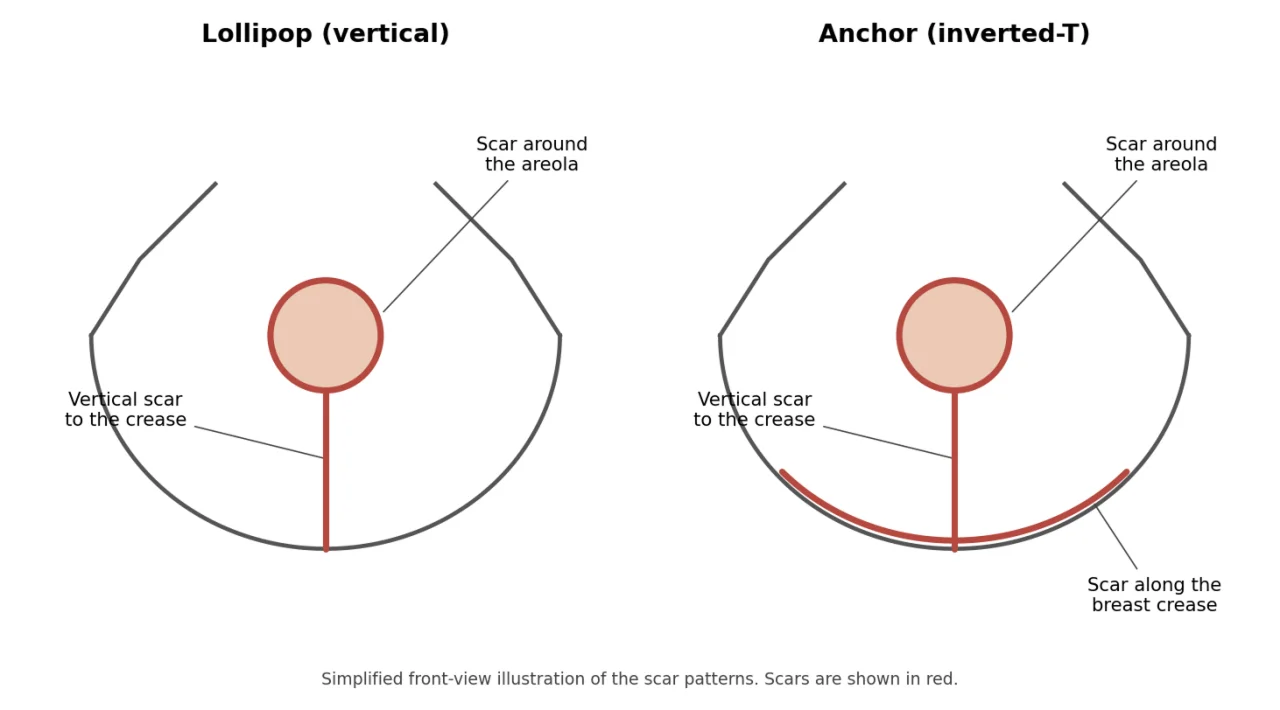
| Vertical (lollipop) | Around the areola, then straight down to the breast crease | Moderate to large reductions with some sagging | Good |
| Anchor (inverted-T) | As the lollipop, plus a line along the breast crease | Larger reductions, or more loose skin | The most scope to reshape and lift |
| Liposuction only | A few tiny scars | A small group with mainly fatty breasts and good skin | Cannot remove skin or lift the nipple |
Lollipop vs anchor: which will I need?
Lollipop is the most common pattern. The anchor is used for larger reductions. Neither is a “better” scar; each is the shorter route to a good shape for a particular breast.
Dr Norris looks at four things when he assesses you:
- Volume to be removed. The more tissue coming out, the more skin usually has to go.
- Skin quality and elasticity. Skin that bounces back well can be tightened through shorter scars.
- Degree of sagging. A lower breast needs more lifting.
- Nipple-to-fold distance. This is the measurement from the nipple down to the breast crease, and it shows how far the nipple has to move.
A shorter scar that leaves a poor shape is not a good trade. Using a lollipop pattern on a breast that needs more skin removed can leave extra skin gathered along the lower scar, which may need a further procedure to correct. Dr Norris will explain which pattern he expects to use, and why, before you decide.
What do breast reduction scars look like as they heal?
Scars change a lot over the first year and a half. Here is a typical pattern, though everyone heals at their own pace.
| Stage | What to expect |
| Weeks 1 to 2 | Incisions are still closing and are covered with dressings or tape. Swelling and bruising are common. |
| Weeks 3 to 6 | Incisions have usually closed. Scars are pink or red thin lines and can feel firm or itchy. |
| 6 weeks to 3 months | Scars are often at their reddest and most raised. This is normal and tends to alarm people. |
| 3 to 6 months | Scars begin to flatten and soften. The red starts to fade. |
| 6 to 12 months | Scars become paler and flatter, though they can still change. |
| 12 to 18 months | Scars are mature: fine, pale lines that usually sit under a bra or bikini top. |
Please do not judge your final scars before the six-month mark.
Itching, tingling and a pulling feeling along the scars are common during this time. They usually ease as the scars soften. If a scar becomes painful, hot, swollen or starts to leak, call the clinic rather than waiting.
What affects how well breast reduction scars heal?
Some of it is in your hands, and some is not.
- Genetics and skin tone. Some people tend to form raised (hypertrophic) or overgrown (keloid) scars.
- It cuts blood supply and slows healing.
- Wound tension. Pull on the incision can stretch the scar.
- It can delay healing and worsen the scar.
- The T-junction. Where the vertical and crease scars meet, healing is often slowest.
- Sun exposure. Sun can darken a healing scar.
- Weight change. Large swings can stretch the skin around the scar.
How to care for your breast reduction scars
Your surgeon’s instructions come first, because timing matters. In general:
- Wear your support bra as directed, to reduce tension on the incisions.
- Keep surgical tape on for as long as you are told.
- Start silicone gel or sheets only once the wounds have fully closed and your surgeon clears you. International scar management guidelinessupport silicone for this.
- Begin scar massage when you are cleared to.
- Use sunscreen and cover your scars from the sun for the first 12 months.
- Do not smoke.
Ask before you try other creams or oils. There is limited evidence that products such as vitamin E help surgical scars, and some can irritate healing skin.
Our breast reduction recovery guide and article on reducing swelling and bruising cover the wider recovery.
What if a scar becomes raised or stretched?
Most scars settle on their own. A few become thick or red, or widen over time. A hypertrophic scar is raised but stays within the line of the incision. A keloid grows beyond it. A stretched scar is simply wider and flatter than it started. If that happens, options include steroid injections, laser treatment, and scar revision surgery once the scar has matured. Each is assessed individually, and none can promise a particular result.
Tell Dr Norris early if a scar looks or feels different from what you expected. It is much easier to help in the first few months.
Scar revision is usually considered only after the scar has fully matured, often around the 12 to 18 month mark, so patience is part of the plan.
Will the scars show in a bra or bikini?
Usually not. A bra or bikini top normally covers the areola scar and the lower breast. With an anchor pattern, the ends of the crease scar may show in very low-cut swimwear.
Planning your breast reduction
You will have two pre-operative consultations and at least a seven-day cooling-off period before surgery can be booked, under the Medical Board of Australia’s cosmetic surgery guidelines. Dr Norris asks for a GP referral, and a second opinion is always welcome. Patients under 18 have a three-month cooling-off period and a psychological assessment.
A Specialist Plastic Surgeon holds FRACS (Plast) after many years of surgical training, while “cosmetic surgeon” is not a recognised specialty. All surgery carries risks, including scarring, bleeding, infection and changes in nipple sensation (see our article on nipple sensitivity). Medicare may contribute to a breast reduction if clinical criteria are met, but a rebate is never guaranteed (more here).
Frequently asked questions
Do breast reduction scars go away?
No, breast reduction scars are permanent, but they fade significantly. Most are red and raised for the first three months, then flatten and lighten over 12 to 18 months into fine lines that usually sit under a bra or bikini top.
What is the difference between a lollipop and an anchor breast reduction?
A lollipop breast reduction leaves a scar around the areola and a vertical line down to the breast crease. An anchor reduction adds a horizontal scar along the crease. The anchor pattern allows more skin removal, so it suits larger reductions.
How long do breast reduction scars take to heal?
Breast reduction incisions usually close within two to three weeks, but the scars take 12 to 18 months to mature. They often look reddest between six weeks and three months, so the final appearance should not be judged before six months.
When can I use silicone gel on breast reduction scars?
You can usually start silicone gel or sheets once the incisions have fully closed with no scabs, often two to three weeks after surgery. Wait for your surgeon’s clearance, then apply it as directed, usually for several months.
Will breast reduction scars show in a bikini?
In most cases, no. Breast reduction scars sit around the areola and on the lower half of the breast, so a bra or bikini top usually covers them. With an anchor pattern, the ends of the crease scar may show in very low-cut swimwear.
Can you have a breast reduction without scars?
A truly scarless breast reduction is rarely possible. Liposuction-only reduction leaves tiny scars but suits only a small group with mainly fatty breasts and good skin, and it cannot lift the nipple. Most women need skin removal, which leaves a scar.
Why does the T-junction of an anchor scar heal slowly?
The point where the vertical and crease scars meet carries the most tension and the least blood supply, so small wound breakdowns are more common there. They usually heal with dressings. Not smoking and wearing your support bra lower the risk.
Why choose Dr Norris for breast reduction in Sydney?
- Specialist Plastic Surgeon with FRACS (Plast), MBChB and MMed (ClinEpi), trained for more than 20 years in Sydney and overseas. AHPRA specialist registration in Surgery (Plastic Surgery): MED0001160589.
- Member of the Australian Society of Plastic Surgeons (ASPS) and the Australasian Society of Aesthetic Plastic Surgeons (ASAPS).
- Incision pattern chosen after measuring your breast and skin quality, with minimal-scar techniques used where they suit your anatomy, and scar-care guidance through recovery. See our page on breast reduction surgery in Sydney.
- Surgery in fully accredited hospitals with specialist anaesthetists, and ongoing post-operative follow-up.
- Two clinics: Bondi Junction (Level 5, 59-75 Grafton Street, Eastern Suburbs) and Bella Vista (Norwest Private Hospital, Suite 101, 9 Norbrik Drive, Hills District).
You can check Dr Norris’s credentials yourself: ASPS profile, ASAPS profile, RealSelf, Plastic Surgery Hub and the AHPRA register of practitioners.
If scars are your main concern, bring that to your consultation (a GP referral is required) and we will talk it through. You can start with our breast reduction mammoplasty page.
Further reading
- Recovery Breast Reduction Surgery
- How to Reduce Swelling and Bruising After Reduction Mammoplasty Surgery
- Breast Reduction Mammoplasty and Nipple Sensitivity
- Does Medicare Pay for Breast Reduction
Medical references
- Healthdirect Australia. Breast reduction
- British Association of Plastic, Reconstructive and Aesthetic Surgeons. Breast reduction: about the operation
- Gold MH, et al. Updated international clinical recommendations on scar management: use of silicones. Dermatologic Surgery, 2014
- Medical Board of Australia. Guidelines for registered medical practitioners who perform cosmetic surgery and procedures
This article is general information only and is not medical advice. All surgery carries risks, and results and recovery vary between individuals. A consultation with a suitably qualified medical practitioner is needed to assess whether a procedure is right for you. Always seek a second opinion if you are unsure.