

Most women arrive at a first consultation thinking about implant size. Then the surgeon asks where the implant should sit, and the conversation gets more interesting.
So, over or under the muscle? It depends on how much natural breast tissue you have, and your surgeon decides after examining you. For many women with thinner tissue, a dual plane pocket (partly under the muscle) is a widely used option. Here is what each placement means, how they compare and what to ask at your appointment.
Why does implant placement matter?
Placement is one of the three big implant decisions, alongside size and shape. The pocket changes how the breast looks and feels in several ways:
- The slope of the upper breast, from collarbone to the fullest point
- How visible the implant edge is, and whether rippling shows (small waves you can see or feel in the skin)
- How the implant moves when your chest muscle flexes
- How tight and sore the first week of recovery feels
- How clearly a mammogram can see your breast tissue
Placement may also play a part in capsular contracture, which is when the scar tissue around an implant tightens. We cover that in our article on capsular contracture after breast augmentation.
What are the main breast implant placement options?
Four pockets come up most often. The illustration below shows each one from the side.
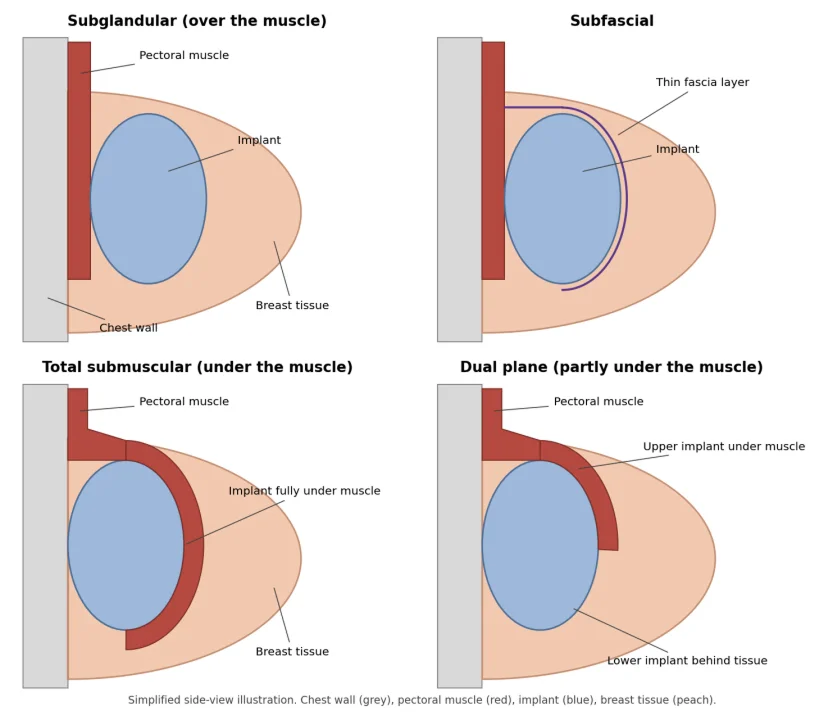
Subglandular (over the muscle)
The implant sits behind the breast tissue and in front of the chest muscle (the pectoralis major). It relies on your own tissue for cover, so it tends to suit women who have plenty of it.
Subfascial
This is a variation on the over-the-muscle pocket. The implant goes just beneath the thin fibrous layer (the fascia) that covers the muscle, which adds a little extra cover.
Total submuscular
The whole implant sits under the chest muscle. That gives the most muscle cover, but the muscle can also pull on the implant when it contracts.
Dual plane
The upper part of the implant sits under the muscle, and the lower part sits behind breast tissue. It is explained in full below.
Not every pocket suits every woman. Dr Norris will explain which options are appropriate for your anatomy.
What is dual plane breast augmentation?
“Dual plane” means the implant sits in two layers. The top is covered by the pectoral muscle, and the lower muscle attachment is released so the bottom of the implant can sit behind the breast tissue instead.
The idea is simple. Muscle gives soft cover where the skin is thinnest and an implant edge is most likely to show. The lower implant can then fill out the bottom curve of the breast.
Surgeons describe three types, based on how much the muscle is released:
- Dual plane I: a small release, for breasts with a well-supported lower pole.
- Dual plane II: more release, for breast tissue that moves a little more freely over the muscle.
- Dual plane III: the most release, for a looser lower pole with some sagging.
Not every surgeon uses these labels in quite the same way, so take them as a rough guide. Where there is a lot of sagging, an implant on its own may not be enough, so your surgeon may suggest a breast lift with implants instead.
Over vs under the muscle: how do they compare?
Neither column below is better. Each is a trade-off, and the right one depends on your body.
| Over the muscle (subglandular) | Under the muscle (including dual plane) | |
| Upper breast slope in thin patients | The implant edge may show more | Muscle softens the upper edge |
| Rippling and edge visibility | More likely when tissue is thin | Less likely at the top of the breast |
| Animation deformity | Not affected by muscle movement | Possible, and varies between women |
| Early discomfort | Usually less | Usually more in the first week |
| Mammogram visibility | The implant may hide more breast tissue | Generally hides less breast tissue |
| Capsular contracture tendency | Some studies report higher rates | Some studies report lower rates |
| Usual candidate | Ample natural tissue, or heavy chest training | Thin to moderate natural tissue |
The evidence on capsular contracture is mixed, and individual results vary.
Which placement suits my body?
Dr Norris looks at several things before recommending a pocket:
- Upper breast thickness. A gentle pinch of the tissue above the breast shows how much natural cover you have.
- Amount of natural tissue overall. Less tissue usually means more reliance on muscle cover.
- Degree of sagging. Lax skin may call for a lift as well as an implant.
- Implant size. A larger implant needs more tissue cover.
- If you do heavy chest training or bodybuilding, muscle movement matters more.
Each of these points in a different direction for different women. That is why the choice is made after an examination, not from a photo or a friend’s experience. Our guide on how to choose breast implants that suit you covers size and shape.
What is animation deformity?
Animation deformity means the breast moves or changes shape when the chest muscle tightens over the implant. Pressing your palms together or carrying heavy shopping bags can make it show.
It happens because part of the implant sits under a muscle that moves. With dual plane placement the lower muscle attachment is released, which may lessen the effect, although how noticeable it is varies between women.
It matters most for very active women, such as those who lift weights several times a week. If that is you, say so early, because it can change the recommendation.
Does placement change recovery?
It can. Under the muscle, the chest muscle is stretched around the implant, so the first week usually feels tighter and sorer than with an over-the-muscle pocket.
The implant also tends to sit high at first and settle more slowly. We explain that settling in our article on drop and fluff. Dr Norris will tell you what to expect for your own recovery, and our guide to returning to exercise covers when you can get back to training.
Does placement affect mammograms or breastfeeding?
Yes, to a degree, for mammograms. An implant can hide some breast tissue on the X-ray. Implants under the muscle generally hide less than those over it, according to the American Cancer Society.
With either placement, tell the radiographer you have implants when you book and again on the day. They can take extra pictures called implant displacement views (Eklund views), which push the implant back and pull breast tissue forward. BreastScreen NSW has information for women with implants.
Breastfeeding is a different story. Placement is only one of several factors, and nothing can be promised either way. Our article on breastfeeding after breast augmentation goes through what is known.
How Dr Norris plans your implant placement
First comes the examination. Dr Norris takes measurements of your chest and breasts, checks how thick your tissue is and how much stretch your skin has, and asks about your goals and day-to-day life. He looks at implant size in the same appointment, since size and placement are linked.
You will have two pre-operative consultations and a cooling-off period of at least seven days before surgery can be booked, as the Medical Board of Australia’s cosmetic surgery guidelines require. Dr Norris asks for a GP referral, and a second opinion is always welcome.
Who you see matters too. A Specialist Plastic Surgeon holds FRACS (Plast) after many years of surgical training. All surgery carries risks, including bleeding, infection, scarring and the need for further surgery. You can read more on our surgery risks and complications page.
Frequently asked questions
Is it better to have breast implants over or under the muscle?
Neither is better for everyone. Under the muscle, often as a dual plane, can suit women with thin breast tissue because it softens the implant’s upper edge. Over the muscle can suit women with ample natural tissue. Your surgeon decides after examining you.
What does dual plane mean in breast augmentation?
With a dual plane pocket, the top of the implant is tucked under the chest muscle and the bottom sits behind the breast tissue. That gives muscle cover where tissue is often thinnest, while the lower half fills the bottom curve of the breast. Surgeons use it widely in breast augmentation today.
Is under the muscle breast augmentation more painful?
Yes, under-the-muscle and dual plane placement usually cause more discomfort in the first week because the chest muscle is stretched. Pain relief is prescribed for this period, and the difference usually settles over the following weeks.
Do under the muscle implants move when you flex?
They can. This is called animation deformity: the implant shifts or the breast changes shape when the chest muscle contracts. How noticeable it is varies, and it tends to show more in women who do heavy chest training.
Do over the muscle implants look less natural?
In women with thin breast tissue, over-the-muscle implants are more likely to show a visible upper edge or rippling. With enough natural tissue over the implant, the edge is less likely to show. A pinch test at consultation guides the choice.
Can breast implants be moved from over to under the muscle later?
Yes. A revision called a pocket change can move breast implants to a new plane. It may be recommended for rippling, capsular contracture or animation deformity, and it is planned after examination and imaging.
Does implant placement affect mammograms?
Yes. Implants under the muscle generally hide less breast tissue on a mammogram. With either placement, tell the radiographer you have implants so they can use displacement views to image as much breast tissue as possible.
Why choose Dr Norris for breast augmentation in Sydney?
- Specialist Plastic Surgeon with FRACS (Plast), MBChB and MMed (ClinEpi), trained in Sydney and overseas. AHPRA specialist registration in Surgery (Plastic Surgery): MED0001160589.
- Member of the Australian Society of Plastic Surgeons (ASPS) and the Australasian Society of Aesthetic Plastic Surgeons (ASAPS).
- Dr Norris chooses the pocket for each patient after measuring their tissue thickness and chest anatomy.See our page on breast implants in Sydney.
- Surgery in fully accredited hospitals with specialist anaesthetists, and ongoing post-operative follow-up.
- Two clinics: Bondi Junction (Level 5, 59-75 Grafton Street, Eastern Suburbs) and Bella Vista (Norwest Private Hospital, Suite 101, 9 Norbrik Drive, Hills District).
You can check Dr Norris’s credentials yourself: ASPS profile, ASAPS profile, Plastic Surgery Hub and the AHPRA register of practitioners.
If you are weighing up placement options, book a consultation (a GP referral is required) and start with a conversation about breast augmentation in Sydney.
Further reading
- Breast Implants “Drop and Fluff” Explained
- Returning To Exercise After Breast Augmentation
- How To Choose Breast Implants That Will Suit Me
- Breast Lift and Implants (Mastopexy with Augmentation Mammoplasty) Sydney
Medical references
- Therapeutic Goods Administration. Breast implants: risks and benefits
- Therapeutic Goods Administration. Breast implants: things to consider before having a procedure
- Kaderbhai A, et al. Breast implants: a guide for general practice. Australian Journal of General Practice, July 2021 (RACGP)
- Cleveland Clinic Journal of Medicine. Breast augmentation surgery: clinical considerations
- American Cancer Society. Mammograms for women with breast implants
- BreastScreen NSW. Screening and breast implants
- NSW Ministry of Health. Information for people with breast implants
- Medical Board of Australia. Guidelines for registered medical practitioners who perform cosmetic surgery and procedures
This article is general information only and is not medical advice. All surgery carries risks, and results and recovery vary between individuals. A consultation with a suitably qualified medical practitioner is needed to assess whether a procedure is right for you. Always seek a second opinion if you are unsure.